The Memory Bookshop
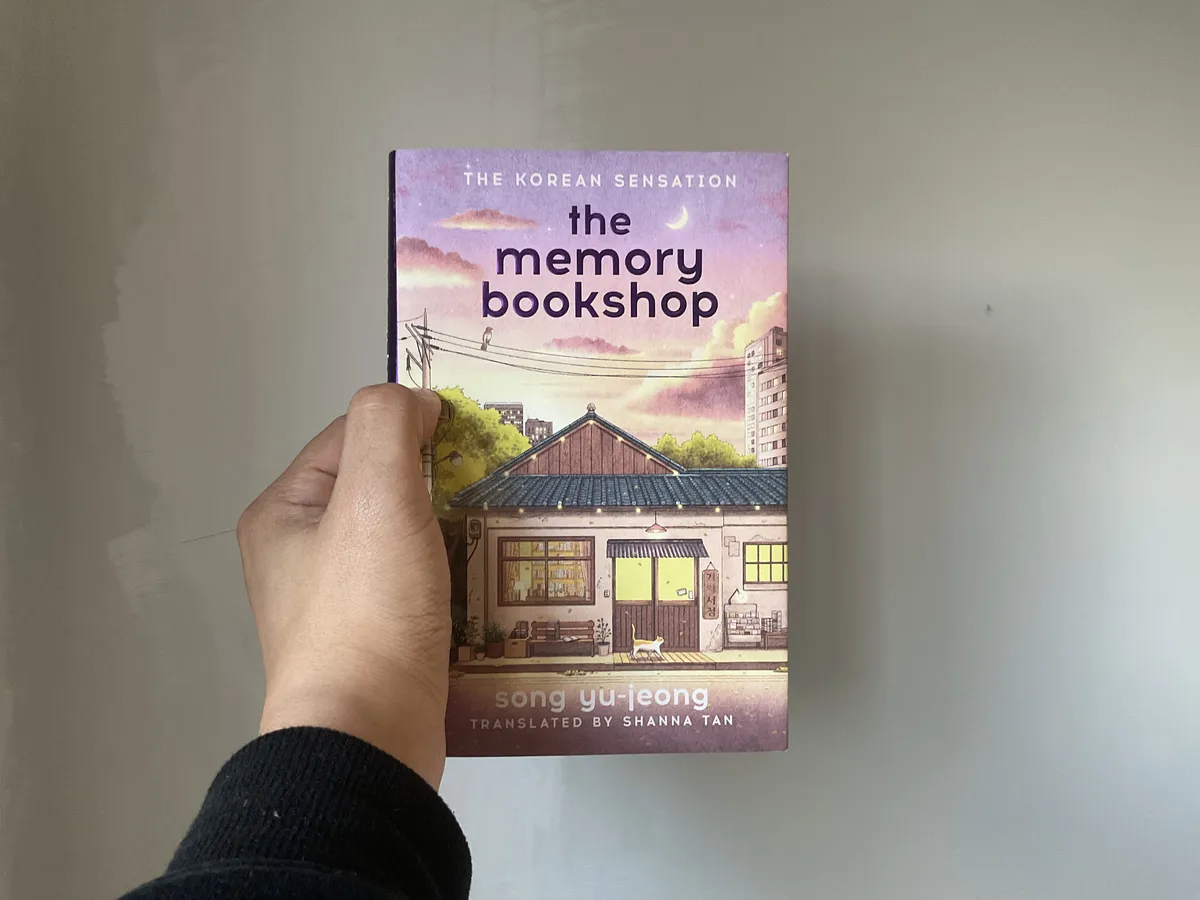
I like, from time to time, to read light books. Stuff that I know won’t leave an impact on me, but that will nevertheless provide a few hours of pure entertainment and a heavy dose of relaxation. Usually, I choose healing fiction, which is that branch of contemporary fiction from Asia dedicated to normal people doing normal things in exceedingly normal places. Sometimes, things are less normal, and elements like time travel or alternate realities are introduced, but always for the sake of highlighting what is normal. Banal situations and actions are described in detail, with the hope that the reader might take away the feeling that there is beauty in simplicity, and that a life doesn’t have to be extra to be beautiful: sometimes, ordinary is just enough.
I find these stories fun for the most part, and read them in between chunkier, heavier books. In just a handful of days, I managed to read Song Yu-jeong’s The Memory Bookshop, which falls perfectly in this category of books. In the novel, a young woman finds a mysterious bookshop in which all of her memories are stored. The manager tells her that she’s allowed to choose three memories to revisit, effectively allowing her to travel back into the past. She can either relive old memories, create new ones, or try to change her grief-stricken present.
I don’t think I have a lot to say about this book, to be honest. It was exactly what I expected, but that’s not to say that I liked it. I’ve now read several of these books, and even if they’re written by different authors, they tend to feel very samey after a while. The structure is the same (almost episodical), and so are the lessons that the protagonist learns by the end. There are genuinely good healing fiction books, I think (Michiko Aoyama’s What You Are Looking For Is In The Library comes to mind), but this one felt a bit too thin and ultimately predictable. I think I prefer these stories without a magical touch. Because, at the end of the day, the magic is predictable and rarely used as an effective metaphor that is not surface level. So these healing fiction books, in my opinion, tend to shine best when there’s no magical gimmick, and so, ordinary moments are highlighted organically and beautifully. The Memory Bookshop relies on its magic a bit too much, and by extension, the ending ends up feeling sticky sweet even when it shouldn’t.
But I did like one thing, though. Through her trips to the past, the protagonist learns that she can reach to old memories to give her the strength she needs. Maybe I’m projecting a bit, but I found it quite romantic. We spend so much time grieving a future that doesn’t exist, dissatisfied by our present. It can be so emotionally taxing. What if the answer we’re looking for is in the past? Not in the sense of not moving away from stuff, but using old, happy memories to remember why sometimes life is worth living. I type this as I’m going through a generally happy time in my life; it will be interesting to revisit this thought through times of trouble instead.